And yet: a year-end letter to organisations that refuse to wait
2025 tested everyone working on climate, social and democratic issues. As we step into 2026, here is a candid look at the year behind us, and the posture we choose for the year ahead.
Let’s be honest about 2025
The world has gone a bit mad. Wars have dragged on, and the human cost has continued to climb. Elections have torn countries apart, hardening political life and narrowing the space for cooperation across lines. Policy reversals on climate, social rights and international cooperation have come fast enough to unsettle long-term planning. Many of the funders, allies and institutions that purpose-driven organisations rely on have wavered, and some have stepped back entirely.
For many of you, this has been a year of doing more with less, and of working in headwinds where there used to be tailwinds. The wind of panic we have seen across boardrooms, NGO leadership teams and federation gatherings has been understandable. We have heard the same questions in nearly every conversation. Should we soften our message? Should we wait for a friendlier moment? Should we even still use the words that defined our work for years?
We have been tested. All of us.

And yet
And yet, you kept going. You kept creating change. You kept refusing to accept the status quo, even when the status quo became louder, harder and more confident.
We saw it in the federations that held their ground on climate ambition when others were quietly rewording their commitments. We saw it in the NGOs that sharpened their advocacy when funding cycles forced them to do less and prove more. We saw it in the public institutions that kept investing in long-term work that nobody was thanking them for. We saw it in the purpose-driven businesses that refused to drop their commitments when the political mood shifted against them.
This year did not break the people who do the real work. In many cases, it clarified them.
What 2025 taught us
A few lessons crystallised through the year. We share them because they shape how we will work in 2026.
First, the volume war is real. The space for serious environmental, social and democratic causes is being crowded by louder, simpler, more cynical voices. Reaching people with nuance is harder than it has been. But nuance still matters, and an audience for it still exists. That audience does not find itself. It has to be sought, and addressed in a language that respects it.
Second, communication has to earn its credibility again. Two decades of vague commitments and decorative claims have thinned the public’s trust in everyone who speaks about impact, including those who deserve to be believed. The work of 2026 is to communicate with evidence behind every claim, and to make that evidence as compelling as the slogans it replaces.
Third, no single organisation will move the needle alone. The shift that brought us to this point was built collectively, across media, publishing, advertising, think tanks and political organising. The countershift needs to be at least as collective. Federations, alliances and coalitions matter more than ever, and so does the work of joining voices that already exist into something larger than any one of them.
What 2026 calls for
We see 2026 as a year for clarity rather than retreat. For more precise messages, not fewer. For collective action over isolated campaigns. For honesty about how hard the work is, paired with the conviction to keep going.
There are good reasons to take this posture. Public support for environmental and social action remains broad across Europe, even where it has gone quieter. New rules on environmental communication arriving in September will reward organisations that have something verifiable to say. The signs of a renewed appetite for collective civic engagement are visible in cities, in workplaces and in the work that committed organisations have not stopped doing.
The choice in front of you, and in front of us, is not between caution and ambition. It is between two ways of doing ambitious work. One waits for an easier moment. The other treats the harder moment as the moment to be sharper, more rigorous and more present.
We choose action, together
That is the choice we are making at MOJO. We choose action. We choose proof. We choose to stand alongside the organisations that refuse to wait for change.
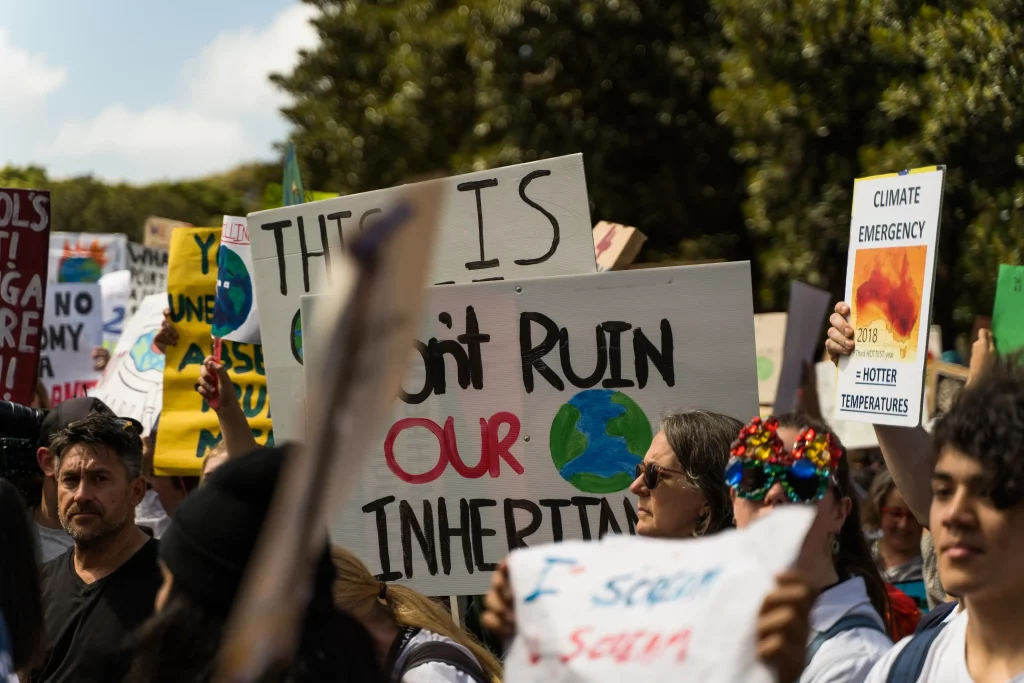
Concretely, for 2026, that means putting more of our energy into the work that matters most. More direct communication that respects the intelligence of its audience. More collective campaigns that join voices instead of multiplying them. More substantiation behind every claim we help craft. More space for the human, the sensitive and the long-term in fields constantly pushed toward the short-term and the loud.
Whatever your organisation is doing in 2026, whether it is tackling climate disorder, defending democracy, fighting poverty, advancing scientific knowledge, protecting nature, supporting healthcare or any of the other causes that make a society worth living in, you are not alone in it.
We are proud to stand alongside you. Thank you for the work you did in 2025. We’re ready to create impact that matters in 2026. Are you?
The MOJO Team
Our latest articles
When collective voices carry further

Creating new narratives to shape the world of tomorrow.